
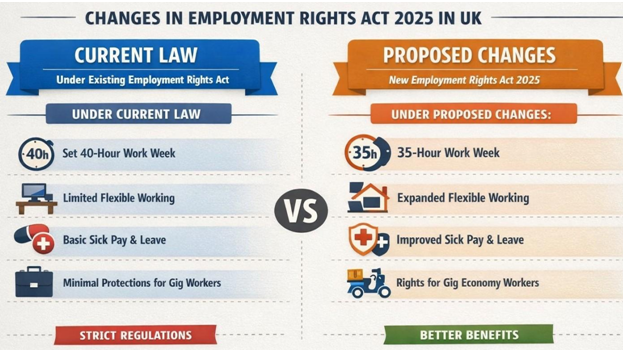
Touted as one of the biggest shake‑ups to UK employment law since the 1996 Act by HR analysts, The Employment Rights Act (2025) became law on Dec. 18th 2025 after The Employment Rights Bill was given royal assent. Not to worry, though! Implementation of the changes in Employment Rights Act (2025) in UK is phased from Dec. 2025 all the way to Oct. 2026 or Q1 of 2027 – enough time to make policy changes, train people professionals, and catch a much-needed holiday! I’ve arranged the rollout timelines in this article. Clear your appointments for the next 15 minutes and let’s analyse the amended legislation.
Watch This Space!
As part of the UK government’s Make Work Pay (MWP) consultations initiative, we’re preparing a webinar for trade unions, employers, and workers to air their concerns on all or part(s) of The Employment Act (2025). Keep it locked!
Changes in Employment Rights Act (2025) in UK: What Really Changed?
The 2025 Act updates existing employment law and introduces new rights around:
- Trade union rights
- Family‑friendly working
- Protection from harassment and discrimination
- Job security and fair pay
- Stronger enforcement of employment law.
The HR department has finally been remembered after a decade!
Immediate Changes
Some changes took effect immediately after the Bill became law. For example, the repeal of the Strikes’ Minimum Service Levels Act of 2023 for keeping essential operations running during strikes
February 18 2026 Changes: Conduct During Industrial Action and Parental Leave
- Starting Feb. 18 2026, dismissal for taking part in industrial action became ‘automatically unfair’ replacing the 12-week unfair dismissal claims limit
- Repeal of a majority provisions in the Trade Union Act (2016) simplified requirements on trade unions on industrial action and removed the 10-year ballot requirement for trade union political funds
- You now need to give notice of industrial action 10 days prior instead of the former 14 days
- Removal of the support threshold requiring at least 40% of the total eligible votes in support of industrial action for both public and private sectors to a simple majority
- Picket supervisors are no longer a legal requirement
- Industrial action mandates will now last for 12 months, NOT 6 months
- Notice period for paternity leave was temporarily reduced from 15 weeks to 28 days (awaiting comprehensive consultations before implementation)
- Newly-eligible (Day 1) employees now have a right to apply for Paternity Leave or Unpaid Parental Leave upon notice
Exemption: The 50% turnout threshold rule for industrial action ballots remain in place until at least August 2026
Changes Effective April 2026
This won’t be the usual April Fools Day – on 1st April 2026, the levy that trade unions and employer associations currently pay to the Certification Officer will cease.
Wait up for April 6 2026 when:
- The new law doubles the maximum period of protective award for failure to consult in collective redundancy to 180 days
- Statutory Sick Pay (SSP) regulation removes the Lower Earnings Limit (LEL) and waiting period from the current fourth day to the first day of illness
- ‘Day 1’ Paternity Leave and Unpaid Parental Leave takes effect. Presently, an employee must have worked for 26 weeks to get ordinary parental leave or 12 months for unpaid parental leave
- The new clause strengthens protection for workers who ‘blow the whistle’ on sexual harassments, making it a ‘qualifying disclosure’ meaning protection from detriment or unfair dismissal
- A non-MWP measure dubbed “Bereaved Partners’ Paternity Leave” enables bereaved fathers or partners to take up to 52 weeks of paternity leave if the mother or primary adopter dies within the first year of a child’s birth (including surrogacy), adoption placement, or entry to the Great Britain for overseas adoption
Important Note: Bereaved Partner’s Paternity Leave will remain as a separate, independent legislation
- Restrictions on taking paternity leave after shared parental leave will be removed
- Action plans on gender equality or supporting employees through the menopause (voluntary) guidance are kickstarted. Gender pay gap and menopause action plans become mandatory in 2027
- The Act also simplifies the trade union recognition process effective April 6 2026
On Tuesday, April 7 2026, the Employment Act (2025) expects establishment of The Fair Work Agency that brings together existing enforcement bodies and takes on enforcement of other employment rights such as holiday pay
Measures in August 2026
Before close of August 2026, there shall be electronic and in-person voting for Statutory Trade Union Ballots in all matters of industrial action, union elections, or other statutory ballots.
Amendments Effective October 2026
Some changes like the employment tribunal time limits will take place earlier than October 2026. Here’s what The UK Employment Act (2025) projected to be changed in October 2026 subject to government consultations:
- Enactment of regulations that establish the Fair Pay Agreement Adult Social Care negotiating body
- Implement the two-tier procurement code to avoid having different terms and conditions for ex-public sector employees and private sector employees
- Tipping laws will be tightened. Employers shall:
- Engage workers or their recognised representatives before drafting a tipping policy
- Making a claim to the tribunal will increase to 6 months for all claims from the current 3-month limit for most claims
- Update the tipping policy every 3 years
- Create an employment tribunal
- The Act leaves the duty to inform workers of their right to join a trade union with the employer
- A new right to reasonable accommodation and facilities for trade union representatives whilst carrying out their duties
- Right to time off for union equality representatives to carry out their duties
- Strengthened trade unions’ right of access to the workplace
- Employers are required to take ‘all reasonable steps’ to prevent sexual harassment of employees
- The employer will be obligated not to permit the harassment of employees by third parties
- Recognition processes for unfair practices in trade unions; with new rights and protections for trade union representatives
- Extended protections against detriments due to taking industrial action
- Changes to the non-disclosure agreements (NDAs) law are expected; thus invalidating any previous statutes that prevented workers from alleging or disclosing work-related harassment / discrimination
December 2026 Updates
In December 2026, The Employment Act (2025) shall have one major event: the enactment of a Mandatory Seafarers’ Charter with higher standards around health & safety, pay, job security, and rest breaks.
January 2027 Changes
Another Important Note: Implementing most of the January 2027 changes will be dependent on the ongoing government consultations.
Our Guarantee to CIPD Members
We shall write ALL assignments using the updated Code of Practice to showcase The UK Employment Act (2025) changes in your CIPD order. Click here to Place an Order TODAY!
- Originally expected in October 2026, dismissing employees then rehiring them on worse terms & conditions (fire-and-rehire) will be deemed unfair dismissal starting January 1 2027.
- The right to protection from unfair dismissal after 6 months at a job is introduced: currently, one must have worked for 2 years with one employer before claiming unfair dismissal
- Limits on compensatory awards for unfair dismissal are removed
Protection from unfair dismissal was to be a right from Day 1 of employment, but the government changed this before the Bill became law. Crazy, isn’t it?
Other UK Employment Law Changes in 2027
There is pin-drop silence from the government on specific dates in 2027 when the following changes will happen. But we’re sure they’re slotted for next year after consultations, no doubt about that!
- Increased pregnancy and maternity rights – The Employment Act (2025) will strengthen protections against dismissal for pregnant workers and new mothers in 2027
- Unpaid Bereavement Leave becomes a statutory right. Bereavement will also include pregnancy loss
- Workers on zero-hours and low-hours contracts get the right to guaranteed working hours (if they want them)
- Workers will be compensated for cancelled / postponed shifts, or sessions cut short by the employer with commensurate short notice payments
- An amendment to flexible working law provides that in 2027, an employer may reject a request due to a genuine business reason but they must:
- State specific justifications from a list of 8 acceptable reasons
- Explain why the said refusal is reasonable
Doing this is already good HR practice today, but it will become a regulatory requirement in 2027.
- Following the earlier changes in October 2026, the new law will specify what ‘reasonable steps’ means when preventing sexual harassment in 2027
- Under collective redundancy,
- Employers shall report the total number of redundancies across the organisation, NOT individual workplaces
- There shall be increased collective redundancy protection for workers on ships operating from British ports but registered outside Great Britain
- 2027 promises UK trade unions the following changes:
- Extension of laws protecting unionised members from discrimination and ‘blacklisting’
- Workers will vote electronically for trade union recognition and derecognition ballots
- Regulation of Umbrella Companies: the definition of agencies will expand to include ‘umbrella companies’ allowing enforcement by relevant UK bodies
Relevance of Changes in The UK Employment Act (2025) to Your CIPD Qualifications and Career
While not every provision of The Employment Act (2025) will directly apply to every CIPD student or employer, they’ll strengthen existing assignment obligations by increasing employer expectations of fairness, transparency, and consistency. Going forward, our CIPD Levels 5 and 7 assignment assistance will keep your submission accurate and up-to-date. With our team of expert writers, staying compliant to The Employment Act (2025) in affected ACs doesn’t have to be your worry anymore!
Need help with CIPD Level 3, 5, or 7 Assignment? Talk to our 24/7/365 Customer Desk and get an A+ paper even for that URGENT order! Our practicing consultants are baking an Employment Rights Act training bundle designed to mentor CIPD members on key evolving areas of employment law under The UK Employment Rights Act (2025). Stay tuned!
What it Means for You
We’re committed to keeping your CIPD papers practical, legally accurate, and updated so you can focus on your career without assignment anxieties. The table below summarises how The UK Employment Rights Act’s (2025) upcoming legislative changes will affect your CIPD profession map: