
You are only a step away from achieving the highest CIPD qualification in the world. You wouldn’t trade anything with 7CO04 business research project proposal help for CIPD Level 7, or would you? Every apprentice wants to pass the 7CO04 final report on the first submission. Start with a solid proposal!
This guide shows you exactly how to structure your 7CO04 business proposal AND where our expert support gives you an edge. If you need custom assistance with your last CIPD business report proposal, read to the end!
Do CIPD Level 7 Students Need a Business Proposal?
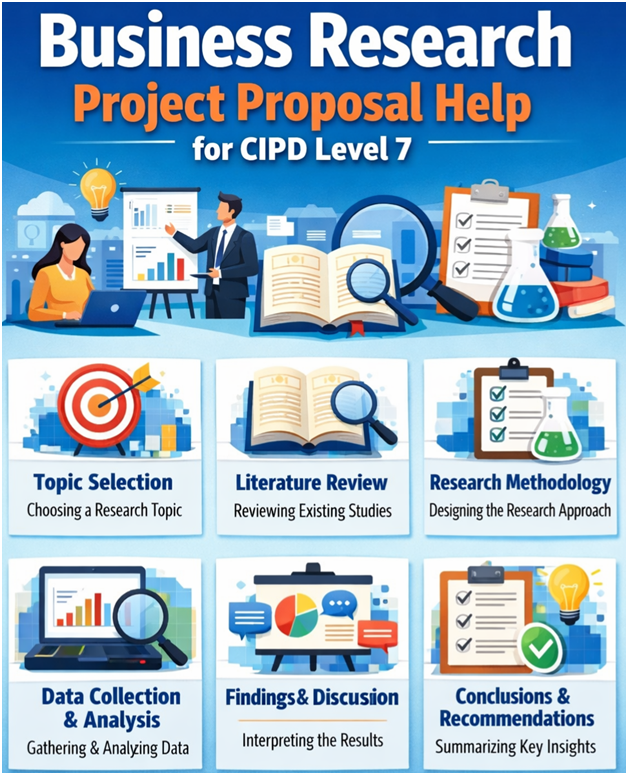
Yes, CIPD students at Level 7 need an approved business research proposal in People Practice for the 7CO04 module. The proposal and final report comprise the EPA for this unit. It is the last assignment aimed at proving a practitioner’s ability to design, conduct, and evaluate a rigorous business research addressing real people-practice challenges.
After a learner identifies an organisational issue, they proceed to critically review relevant academic and professional literature. Next, propose justifiable research methodologies. Each CIPD Level 7 business research proposal concludes with translating evidence-based findings into practical, ethical, commercially sound recommendations for stakeholders.
In Brief: CIPD students need a strong research proposal to pass Module 7CO04. A proposal shows that the upcoming research question is focused, justified by evidence, ethically sound, and achievable. The proposal is a bridge between academic success and tangible organisational value.
8 Major Challenges CIPD Students Face While Drafting a 7CO04 Research Proposal
From client feedback in 2025, these are the 8 major challenges CIPD students face while drafting a 7CO04 research proposal:
- Topic selection and scoping
- Conducting a critical literature review
- Formulating clear research questions
- Choosing and justifying a research methodology
- Addressing ethical business research issues
- Time and project management
- Issues with stringent academic writing and structure, AND
- Gaining organisational buy-in or access to confidential organisational data / participants
Professional CIPD Level 7 Business Proposal Assistance Boosts Your Chances of Approval!
We strictly follow the proven “Pain ~ Solution ~ Benefit” path for CIPD students who lack the time or confidence to approach 7CO04. Our service offers topic selection, ToR drafting, literature review, help with methodology & data analysis, and writing organisational requests for business research approval.
Get a Personalised Quote for Your 7CO04 Business Proposal!
24/7/365 Customer Service desk. Fast turnaround even for emergency orders. Customised, plagiarism-free organic content. Evidence-based, ethically grounded research. Expert CIPD-qualified writers with 5+ years of practicing experience. The most affordable service for our QUALITY. Place an Order TODAY!
What Learning Outcomes (LOs) Are Associated With 7CO04?
The CIPD Level 7 business research in people practice (Unit 7CO04) covers four primary LOs from research conception to recommendations and reflection:
- LO1: Ability to plan a people practice business research project to add organisational value including justifying Terms of Reference (ToR), conducting critical literature review, and developing authoritative research questions
- LO2: Ability to justify appropriate research methodologies for data collection, differentiating data types, justifying choices, discussing limitations, and assessing ethical research issues
- LO3: Ability to analyse data for decision-making and provide business / people management insights through effective analysis, clear presentation, and discussion of findings
- LO4: Ability to propose recommendations based on research conclusions including: justifying conclusions, proposing business-focused recommendations with action plans and cost-benefit analysis, and critically evaluating the research process.
When CIPD students internalise what each Learning Outcome tests, they stop “writing an academic proposal” and design a strategic, assessable business research.
LO1 sets the foundation with research philosophies, evidence-based practice, and organisational context to justify why the chosen topic matters academically and strategically. LO2 positions the research gap, awaiting LO3 to justify sampling, data collection & analysis techniques. LO4 reassures the assessor that your research will lead to actionable organisational impacts, not some academic conclusions.
Why Students Fail in CIPD 7CO04 Proposals
According to numerous assessor observations and our inhouse practicing consultants’ analysis, CIPD Level 7 students who failed at the 7CO04 proposal stage committed these 7 mistakes:
- Lack of clarity on terms of reference and scope
- Difficulty distinguishing primary from secondary data
- Ethical considerations were often ignored
- Many students had weak literature reviews which undermined the research question
- Fear of assessment criteria and academic standards caused avoidable gross errors
- Unsupported methodology choices
- Most disapproved CIPD Level 7 business proposals had no strategic link to organisational value
A professor in the Schengen Area told me this over tea:
“ You know, CIPD Level 7 is masters-level. Many students don’t have a single clue on how to tackle 7CO04. At this point in their qualification, we expect concise, evidence-based work. We appreciate ExpertWritingHelp.com’s resolve to help 7CO04 candidates with research proposal support. It really matters.”
How A+ Students Write Winning 7CO04 Research Proposals
- Title Page and Executive Summary:
Fill in the RESEARCHER INFO template provided immediately after the title. The executive summary explains the people-focused business issue you’ve identified plus a brief explanation of its significance to the organisation. CIPD assessors want a glaring rationale for the business case telling them why your 7CO04 research matters now, its link to company goals, or how it adds value to the profession
- Start Off With Clear Terms of Reference (ToR) to set the compass for your research.
Define the business research aims, objectives, and the scope (tell the assessor where the research will take place / organisational context). Include feasible resources for the study and projected timeframes in a GANTT chart
Pro Tip: Keep the ToR SMART (specific, measurable, achievable, realistic, and time-bound)
- Every Winning Proposal Has a Strong Literature Review
Summarise relevant, authoritative academic / professional sources that directly inform your research problem and questions. Don’t do descriptive summaries – instead, show critical thinking and real-world application of theory to HR practices
- Develop Clear Research Questions (Hypotheses) Early
The characteristics of business research questions are: focused on people practice issues, coherent, answerable, and relevant in modern-day HR environments. Outstanding research questions establish existing literature gaps and align to the ToR!
- Choose, Justify, and Delineate a Detailed Research Design (Methodology)
What are your primary and secondary data sources? Will you use qualitative, quantitative, or a mixed approach? Why is the chosen method the best for achieving the aims in your business case? Describe in detail the project plan showing key stages, deadlines, required resources, and costs (if any)
- Address Research Ethics
Things like informed consent, participant confidentiality, and ethical data storage standards (See GDPR statutes) determine whether your 7CO04 business research proposal will be approved or not
- Data Collection Tools & Strategy
How and from whom will you collect data? Which tools will you use (document analysis, surveys, focus groups, interviews, etc)? Justify the chosen sampling technique and list down anticipated data collection challenges alongside evidence-based mitigation measures
- Data Analysis Plan
How will you use coding, thematic analysis, or statistical methods to interpret data? Every high-pass CIPD Level 7 business project proposal links back data analysis to the research questions
- Expected Outcomes and Impacts to the HR Profession
State the findings you anticipate from your business research. List and explain the value of your study to the organisation’s people practice strategy. Identify the impacts of the research findings to the HR profession: for example, what management insights can people professionals draw from the culminating business report?
- Reporting, Recommendations & Cost-Benefit Analysis
Present findings clearly. Tell the audience what your organisation stands to gain from the 7CO04 business proposal. You may recommend implementation actions or add a cost-benefit analysis to show business value
FAQs
1. What is the Standard Word Count for a CIPD 7CO04 Project Report?
Although the word count is explicitly mentioned in the Level 7 assessment brief, most centers have a 4,000 – 10,000 words limit.
2. Can I Submit the Final Project Report Alongside the Proposal?
No. You should first submit the 7CO04 business research proposal for approval with your CIPD center before conducting the actual study.
3. Can I Change the Title, Methodology, or Analysis Tools in the Final Paper?
You CANNOT change the title, methodology, analysis tools, or any other part of the proposal in the final paper after approval.
33 Examples of Best CIPD 7CO04 Research Proposal Topics for 2026 Cohorts
You can borrow any of these 33 examples of best CIPD 7CO04 research proposal topics for 2026 cohorts. I’ve clustered the sample titles under 7 strategic HR areas and contemporary themes:
Also explore more free CIPD 7CO04 research project Ideas here
Diversity, Equity, Inclusion, and Belonging (DEIB)
- Moving DEIB from Initiative to Infrastructure: Successful strategies for embedding inclusion into performance evaluations and recruitment HR practices.
- Does Pay Transparency Improve Employee Trust and Reduce the Gender Pay Gap? An analysis of Saudi Arabia’s reporting laws and the impact of open salary bands.
- Inclusive HR Policies for a Neuro-Diverse Workforce: Identifying best practices for supporting autistic and other neurodivergent employees in a corporate setting.
- The Role of Belonging in Remote Teams: Strategies for fostering social connection and inclusive cultures in distributed work environments.
Talent Acquisition & Retention
- The True Impact of Employer Branding on Talent Retention: Beyond perception to quantifiable results – a case study of Tenaga Nasional Berhad (Malaysia).
- The Gig Economy and Workforce Planning: How Golf Saudi can integrate contingent workers into the strategic workforce model.
- Optimizing Internal Mobility: Analyzing the effectiveness of internal mobility programs in reducing hiring costs and improving Qatar Airways’ top talent retention.
- Candidate Experiences in the Age of AI Jobseeker Screening: How to achieve a human-centered, fair recruitment process despite advances in automation.
The Future of Work and Organisational Design
- Optimizing Productivity and Well-being Through Hybrid Work Models: An investigation into the balance between remote and in-office working for Hamad International Airport’s employee groups.
- The Rise of the Skills-Based Organisation: A comparative analysis of job-based versus skills-first approaches to talent acquisition and career pathing at Ma’aden Mining Company (Saudi Arabia).
- Managing a Multi-Generational Workforce: Developing inclusive L&D programs to address diverse needs and expectations of different age demographics at UN Women (Pakistan).
- The Role of HR in Fostering Agile Workplace Cultures: A study of cross-functional team structures and their impact on organisational adaptability.
- Is the 4-Day Workweek a Viable Strategy for the UK Market? An evidence-based analysis of productivity, engagement, and business viability of compressed work hours.
- The Effectiveness of Internal Talent Marketplaces: An assessment of the impact on internal mobility, talent retention, and cost savings.
Artificial Intelligence (AI) and Technology in HR
- Ensuring Ethical AI in Recruitment: A study on human-centered governance to mitigate biases in AI-driven hiring algorithms.
- Tackling Techno-stress and Fear of Becoming Obsolete (FOBO): Developing a HR intervention to manage employee anxiety out of AI integration in the workplace.
- The Impact of HR Chatbots on Employee Experiences: An analysis of efficiency gains versus the need for human touch-points in employee queries.
- AI Fluency as a Core Employee Competency: Assessing the current AI literacy levels in Cape East LLC’s HR departments for designing a practical L&D program.
- Predictive People Analytics in Talent Management: Evaluating the effectiveness of data-driven AI models in forecasting high-potential employee attrition.
- Optimizing Workflow Through Agentic AI: A case study on using AI agents to automate multi-step HR processes at Pepsi Asia while maintaining human oversight.
- Data Protection and Privacy in AI-Powered HR Systems: Evaluating Etihad’s compliance with GDPR regulations when using advanced people analytics platforms.
Employee Engagement, Wellbeing, and Culture
- Burnout as a Board-Level Hazard: The effectiveness of psychological health and safety interventions in minimizing business risks.
- Rebuilding Employee Engagement Through Effective Management: The role of manager coaching skills in improving employee morale and productivity in a hybrid work environment.
- Perks to Purpose: How values and meaningful work contributes to employee retention in 2026.
- Strategies for Combating “Quiet Cracking”: Fighting subtle employee disengagement by developing strategic interventions which prioritise employee recognition.
- Impacts of Comprehensive Mental Health Support: A study on how proactive mental health approaches affect absenteeism and employee well-being.
- Designing an Optimal Employee Experience: Using employee journey maps to identify and mitigate employee lifecycle friction points.
Strategic HR and Compliance
- Aligning HR Strategy with Organisational Resilience: How the people function should plan for climate-driven disruptions and geopolitical changes.
- From HR Support to Strategic Business Partner: A roadmap for HR to use data analytics in professional development.
- Assessing and Managing Psychosocial Risks in the Workplace: Implementing the ISO 45003 global standard for mental health safety.
Learning & Development (L&D)
- The Effectiveness of Gamification in Corporate Training – Measuring learning outcomes and engagement in L&D programmes.
- Micro-certifications is the New Currency: Evaluating the effectiveness of bite-sized, skill-focused learning on skill gap reduction and career progression.
- Building the “Learning How to Learn” Meta-Competency: L&D programs that enable employees to independently source or evaluate knowledge.