
At Level 7, the strongest submission is one that compares 2–3 contrasting theories / models per AC, questions assumptions, evaluates evidence, and make defensible strategic business judgements. The 20 master models for CIPD Level 7 assignments in this article apply to the four core units, three pathway units, and one optional unit.
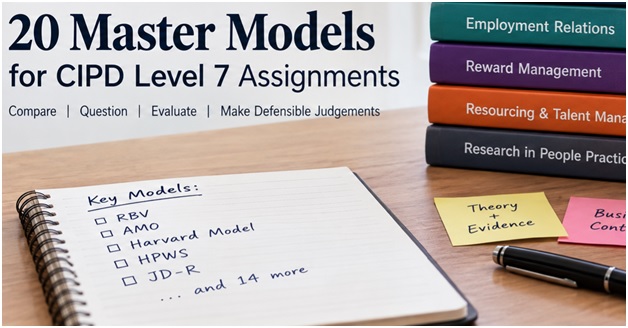
20 Master Models for any CIPD Level 7 Assignment
Our expert writers with 13+ years of CIPD Level 7 experience will intricately apply the following 20 master models for CIPD Level 7 assignments into your paper, leaving assessors with no option but to award you an A+ grade:
- Resource-Based View (RBV)
Strategy, talent, competitive advantage, HR strategy
- AMO Model
Performance, engagement, talent
- Harvard HRM Model
Strategic HR, stakeholders, HR policy
- Best Fit vs Best Practice
Strategic HRM, HR architecture
- High Performance Work Systems (HPWS)
Performance, productivity, strategic HR
- McKinsey’s 7-S
Alignment, culture, change
- Institutional Theory
Global HR, Employee relations (ER), regulation, organisational context
- Stakeholder Theory
Strategy, ethics, Corporate Social Responsibility (CSR), influence
- PESTLE
External environment, labour market, strategy
- Social Exchange Theory
Engagement, voice, retention, ER
- Psychological Contract
Engagement, reward, retention, ER
- Organisational Justice
Reward, fairness, ER, Equity / Diversity / Inclusion
- Job Demands–Resources (JD-R)
Wellbeing, engagement, performance, flexible work
- Change models: Lewin, Kotter, ADKAR
Change, resistance, transformation
- Unitarist / Pluralist / Radical perspectives
Employee relations
- Hofstede / GLOBE / institutional perspectives
International people management
- Total Reward
Reward strategy, motivation, retention
- Agency Theory
Executive reward, governance
- Socio-Technical Systems Theory
AI, technology, work design, digital HR
- Evidence-Based Management / Research methodology
(virtually every assignment)
Where do I Use the Models in CIPD Level 7 Assignments?
At this advanced level, assessors expect your chosen model to be a lens through which you evaluate an organisation, NOT an answer in itself. Let’s see where to use the 20 master models in CIPD Level 7 assignments:
Unit I. 7CO01: Work and Working Lives
Hurry and Place Your Order today before the limited-edition discount for any CIPD Level 7 assignment lapses!
AC 1.1: Globalisation
⭐ Globalisation theory, Bartlett & Ghoshal, Porter’s Diamond, global value-chain theory, convergence / divergence principles
AC 1.2: Technological trends
⭐ Socio-technical systems theory, Technology Acceptance Model (TAM), Job Demands–Resources (JD-R), technological determinism vs social shaping of technology, recent automation / augmentation perspectives
AC 1.3: Social / demographic trends
⭐ Demographic transition theory, generational perspectives, Social Identity Theory, Human Capital Theory, employee lifecycle perspectives
AC 1.4: Economic trends
Appraise economic trends using ⭐ PESTLE, labour-market economics, Human Capital Theory, segmentation theory, or precarity / institutional perspectives
AC 2.1: Media, technology, and economic developments
⭐ PESTLE, socio-technical systems, TAM, and digital transformation frameworks
AC 2.2: Public-policy developments
⭐ Institutional theory, stakeholder theory, policy-cycle analysis, PESTLE, regulatory-risk frameworks
AC 2.3: Regulatory developments and risk
⭐ Risk management framework, PESTLE, compliance-risk matrix, institutional theory, or governance models
AC 2.4: Skills supply / demand
⭐ Human Capital Theory, labour supply / demand model, skills-gap analysis, labour-market segmentation theory, signalling theory
AC 3.1: Change management
⭐ Lewin’s Change Model, Kotter’s 8-Step Framework, ADKAR, and Burke–Litwin theory
AC 3.2: Levers for change
⭐ Force Field Analysis; Kotter; ADKAR; psychological resistance/readiness; stakeholder theory; change curve
AC 3.3: Flexible working
⭐ JD-R, Conservation of Resources theory, organisational resilience frameworks, socio-technical systems, Psychological Contract
AC 3.4: People management
⭐ AMO, High Performance Work Systems, Human Capital Theory, Resource-Based View (RBV)
AC 4.1: Ethics / values
⭐ Stakeholder Theory, ethical decision-making frameworks, utilitarianism, deontology, ethical climate theory
AC 4.2: Wellbeing
⭐ JD-R, Conservation of Resources theory, Effort–Reward Imbalance, Demand-Control-Support, PERMA, Psychological Contract
AC 4.3: Sustainability
⭐ Triple Bottom Line, Stakeholder Theory, Carroll’s CSR Pyramid, ESG, Creating Shared Value
AC 4.4: EDI
⭐ Social Identity Theory, Intersectionality, Social Dominance Theory, Equity Theory, similarity-attraction / bias perspectives
Unit II. 7CO02: People Management and Performance Development Strategies
Arguably the most important strategic HR unit, you’re to critique different people-management models, systemic thinking, best-fit / best-practice approaches, resource-based thinking, and high-performance HR frameworks.
AC 1.1: Objectives of people management
⭐ AMO, Human Capital Theory, Stakeholder Theory, Resource-Based View, Harvard Model
AC 1.2: Organisational strategy / culture / brand
⭐ Strategic Fit, McKinsey’s 7-S model, Ulrich framework, Resource-Based View
AC 1.3: Management models
⭐ Harvard Model, Michigan Model, Storey principles, Best Fit vs Best Practice theory, High Commitment HRM, HPWS
AC 1.4: People practice outcomes
⭐ HPWS, AMO, Human Capital theory, Resource-Based View, evidence-based HR-performance causal-chain models
AC 2.1: Developing strategies
⭐ SWOT ⭐PESTLE, Resource-Based View, scenario planning
AC 2.2: Resourcing / performance management
⭐ AMO ⭐High Performance Work Systems, Talent Management models, performance-management cycle
AC 2.3: L&D and organisational design
⭐ 70:20:10 model, Kirkpatrick framework, ADDIE, organisational design contingency theory, Burke–Litwin theory
AC 2.4: ER, engagement and EDI
⭐ Social Exchange Theory ⭐Psychological Contract, AMO, JD-R, employee voice models
AC 3.1: Organising people practice
⭐ Ulrich HR Model, Ulrich’s HR roles, three-legged model, CoE model
AC 3.2: Ethics / professionalism
⭐ CIPD Profession Map, ethical decision-making, virtue ethics, deontology, utilitarianism
AC 3.3: Technology and people management
⭐ Socio-Technical Systems, TAM, digital HR maturity, people analytics principles, algorithmic-management perspectives
AC 3.4: Evaluation of people practices
⭐ Balanced Scorecard ⭐ROI, Kirkpatrick, HR metrics, people analytics, Human Capital Reporting
AC 4.1: External partnerships
⭐ Stakeholder Theory ⭐Power–Interest Grid, value-chain analysis, relational contracting
AC 4.2: People-management challenges
⭐ Contingency Theory, stakeholder theory, organisational life-cycle theory
AC 4.3: People management’s variations
⭐ Hofstede, GLOBE, Trompenaars, convergence / divergence, Bartlett & Ghoshal framework
AC 4.4: Ongoing knowledge of developments
⭐ Evidence-Based Management, PESTLE, horizon scanning
Unit III. 7CO03: Personal Effectiveness, Ethics and Business Acumen
Please don’t force HR strategy models into every answer!
AC 1.1. Responsible decisions
⭐ Utilitarianism, Deontology, virtue ethics, stakeholder ethics
AC 1.2: Employee voice
⭐ Employee Voice frameworks, Social Exchange Theory, psychological safety principles, participation / industrial democracy
AC 1.3: Integrity and professional courage
⭐ Johari Window, emotional intelligence, reflective practice, ethical leadership
AC 1.4: Cultural collaboration
⭐ Social Identity Theory, Cultural Intelligence, Tuckman model, psychological safety, stakeholder theory
AC 2.1: Self-management
⭐ Emotional Intelligence, Johari Window, Big Five
AC 2.2: Commercial awareness
⭐ Business Model Canvas, SWOT, PESTLE, Balanced Scorecard, financial KPI analysis
AC 2.3: Behaviour and organisational values
⭐ McKinsey’s 7-S model, person–organisation fit theories, values congruence
AC 3.1: Deep learning
⭐ Kolb; Double-Loop Learning; Growth Mindset; learning agility
AC 3.2: CPD and reflection
⭐ Gibbs, Kolb, Schön reflective practice, 70:20:10, CPD cycle
AC 3.3: Effective networking
⭐ Social Capital Theory, weak-ties theory (Granovetter), networking / social network analysis
AC 3.4: Promoting success
⭐ SECI Knowledge-Creation Model, Communities of Practice theory, Knowledge Management Cycle
AC 4.1: Complex decision-making
⭐ Rational Decision Model, bounded rationality, Cynefin principles, Vroom–Yetton framework, prospect theory
AC 4.2: Influencing audiences
⭐ Stakeholder Mapping, Cialdini principles, French & Raven power bases, situational influence, active listening methods
AC 4.3: Professional courage
⭐ French & Raven theory, political-skill theory, ethical leadership practices, psychological safety models
AC 4.4: Evidence-based critical thinking
⭐ Evidence-Based Management, triangulation, source appraisal, cognitive-bias frameworks, Six Thinking Hats
Unit IV. 7CO04: Business Research in People Practice
Models are less about HR theories and more about research design, epistemology, validity, reliability, data analysis, and evaluation.
AC 1.1: Research terms of reference
⭐ SMART objectives, research onion, problem-aim-objective framework, logic model
AC 1.2: Literature review
⭐ PRISMA-style systematic review principles, thematic synthesis, evidence hierarchy, conceptual framework
AC 1.3: Research questions
⭐ PICOT / PICO where applicable, deductive vs inductive reasoning, conceptual framework
AC 2.1: Research methods
⭐ Research Onion, Saunders’ methodology framework, Creswell research designs, qualitative / quantitative / mixed methods
AC 2.2: Limitations
⭐ Validity, reliability, generalisability, sampling error, researcher bias, internal / external validity
AC 2.3: Research ethics
⭐ Ethical research principles, informed consent, confidentiality, anonymity, data-governance framework
AC 3.1: Raw data analysis
⭐ Descriptive statistics, inferential statistics, thematic analysis, coding, correlation / regression (where appropriate)
AC 3.2: Primary research data
⭐ Data visualisation, narrative analysis, dashboard principles, thematic presentation
AC 3.3: Findings
⭐ Triangulation, thematic synthesis, comparative analysis, evidence integration
AC 4.1: Conclusions
⭐ Evidence chain, triangulation, logic model, abductive reasoning
AC 4.2: Recommendations and cost-benefit analysis
⭐ Cost-Benefit Analysis, ROI, business-case model, risk matrix, implementation roadmap
.
AC 4.3: Research experience
⭐ Gibbs, Schön, Kolb, after-action review, lessons-learned framework
Pro Tip
For CIPD Level 7, memorise this research chain:
Business Problem → Research Aim → Objectives → Literature Review → Research Questions → Methodology → Data → Analysis → Findings → Conclusions → Recommendations → Business case → Reflection
Unit V. 7HR01: Strategic Employment Relations
We think: Frame of reference → Power / voice → Organisational outcome instead of the bland Policy → Procedure → Recommendation.
AC 1.1: ER perspectives
⭐ Unitarist ⭐ Pluralist ⭐ Radical / Marxist, Systems Theory, Strategic Choice
AC 1.2: Cooperation vs conflict
⭐ Fox’s Frames of Reference, conflict theory, psychological contract, social exchange
AC 1.3: Employer strategies toward unions
⭐ Partnership model, adversarial model, pluralist theory, union substitution, strategic choice
AC 1.4: Employment relations (ER)
⭐ High-trust ER, Social Exchange theory, Psychological Contract, employee voice mechanisms
AC 2.1: International influences
⭐ Institutional theory, convergence / divergence, Varieties of Capitalism, globalisation theory
AC 2.2: ER under competitive pressures
⭐ PESTLE, labour-market theory, strategic choice, contingency theory
AC 2.3: External advice
⭐ Stakeholder Theory, institutional theory, evidence-based decision-making
AC 2.4: Changing nature of work
⭐ Labour-market segmentation, precarity theory, gig-economy perspectives, technological determinism
AC 3.1: Indirect employee voice
⭐ Works councils, partnership model, industrial democracy, collective voice theory
AC 3.2: Direct vs Informal voice
⭐ Employee Voice, psychological safety principles, AMO, Social Exchange Theory
AC 3.3: Voice and outcomes
⭐ AMO, Social Exchange theory, HPWS, employee-engagement models
AC 3.4: Employee engagement
⭐ Kahn’s Engagement Theory, JD-R, Social Exchange theory, Psychological Contract, Utrecht Work Engagement model
AC 4.1: Collective bargaining
⭐ Dunlop’s Industrial Relations System, pluralism, collective bargaining theory, power theory
AC 4.2: Employer–union negotiation
⭐ Interest-Based Bargaining, distributive / integrative negotiation, BATNA, Thomas–Kilmann framework
AC 4.3: Third-party dispute resolution
⭐ ADR framework, mediation, arbitration, conciliation, conflict-resolution models
AC 4.4: Grievance and disciplinary procedures
⭐ ACAS framework ⭐Procedural Justice principles, organisational justice, natural justice, Psychological Contract
Unit VI. 7HR02: Resourcing and Talent Management to Sustain Success
AC 1.1: Talent and business environment developments
⭐ PESTLE, labour-market analysis, scenario planning, Resource-Based View
AC 1.2: Resourcing strategies
⭐ Resource-Based View, Talent Management architectures, build / buy / borrow principles, Best Fit theory
AC 1.3: Future talent
⭐ Scenario planning, workforce ecosystem, strategic workforce planning, contingent workforce models
AC 1.4: Employer reputation
⭐ EVP framework, Employer Brand principles, Psychological Contract, Signalling Theory
AC 2.1: Job analysis, design & competency
⭐ Job Characteristics Model, competency frameworks, Hackman & Oldham theory
AC 2.2: Recruitment and selection
⭐ Validity & Reliability principles, person–job / person–organisation fit, criterion validity, structured-selection model
AC 2.3: Recruitment technology
⭐ Technology Acceptance Model (TAM), socio-technical systems, algorithmic bias, human-in-the-loop framework
AC 2.4: Induction & onboarding
⭐ Organisational Socialisation Theory, Psychological Contract, the 4Cs of onboarding, employee lifecycle
AC 3.1: Workforce planning
⭐ Strategic Workforce Planning cycle, demand / supply analysis, scenario planning, skills-gap analysis
AC 3.2: Retention analytics
⭐ People and predictive analytics, cohort / survival analysis, turnover metrics
AC 3.3: Voluntary turnover
⭐ Job Embeddedness, Psychological Contract, Herzberg, JD-R, Social Exchange theory
AC 3.4: Succession planning
⭐ 9-Box Grid, talent-pipeline model, succession planning cycle, R-BV
AC 4.1: Performance management
⭐ AMO, Goal-Setting Theory, Expectancy Theory, HPWS, coaching approach
AC 4.2: Technology for performance monitoring
⭐ Socio-technical systems, algorithmic management, surveillance / privacy frameworks, JD-R
AC 4.3: Attendance / underperformance management
⭐ JD-R, performance models, supportive performance approach, Psychological Contract
AC 4.4: Retirement, redundancy and dismissal
⭐ Procedural Justice, organisational justice, stakeholder theory, ethical decision-making, risk framework
Unit VII. 7HR03: Strategic Reward Management
AC 1.1: Factors influencing reward strategy
⭐ Strategic Fit, Total Reward theory, PESTLE, contingency theory, Reward Context Model
AC 1.2: Reward and organisational strategy
⭐ Vertical / Horizontal Fit theory, McKinsey’s 7-S model, Total Reward, AMO
AC 1.3: Reward benchmarking
⭐ Market positioning, external / internal equity, data-quality framework
AC 1.4: Reward and attraction / motivation / retention
⭐ Equity Theory, Vroom, Herzberg, Total Reward theory, Psychological Contract
AC 2.1: Total reward
⭐ Total Reward Model, intrinsic / extrinsic motivation, Self-Determination Theory, AMO
AC 2.2: Base pay
⭐ Equity Theory, Expectancy Theory, labour-market theory, efficiency-wage theory
AC 2.3: Contingent reward
⭐ Vroom, Goal-Setting Theory, reinforcement theory, Equity Theory, crowding-out effect
AC 2.4: Employee benefits
⭐ Total Reward, Social Exchange Theory, Psychological Contract, Maslow hierarchy, utility theory
AC 2.5: Non-financial rewards
⭐ Herzberg, Self-Determination Theory, Job Characteristics Model, Psychological Contract
AC 3.1: Pay structures
⭐ Job Evaluation model, market pricing principles, internal / external equity, pay architecture
AC 3.2: Incremental pay
⭐ Equity Theory, tournament theory, labour economics
AC 3.3: Pay appraisal / progression
⭐ Goal-Setting Theory, Vroom, performance-management theory, organisational justice, appraisal-bias theory
AC 3.4: Remuneration committees and executive reward
⭐ Agency Theory, Stewardship Theory, tournament theory, corporate governance best practices, executive pay theory
AC 3.5: Reward factors
⭐ Hofstede, institutional theory, global reward strategy, purchasing power / cost-of-living frameworks
AC 4.1: Reward legislation
⭐ Equal Pay framework, legal compliance, risk management, equality / fairness analysis
AC 4.2: Job evaluation
⭐ Point-Factor / factor comparison framework
AC 4.3: Ethical contingent reward
⭐ Equity Theory, procedural / distributive justice, ethical decision-making, motivation crowding
AC 4.4: Reward transparency
⭐ Organisational Justice, Equity Theory, Psychological Contract, Social Exchange theory